What Is the Manaslu Circuit Trek?
The Manaslu Circuit Trek is more challenging than most popular Nepal treks due to its remote terrain, high altitude, limited infrastructure, and long trekking duration in isolated Himalayan regions.
Where is the Manaslu Trek located?
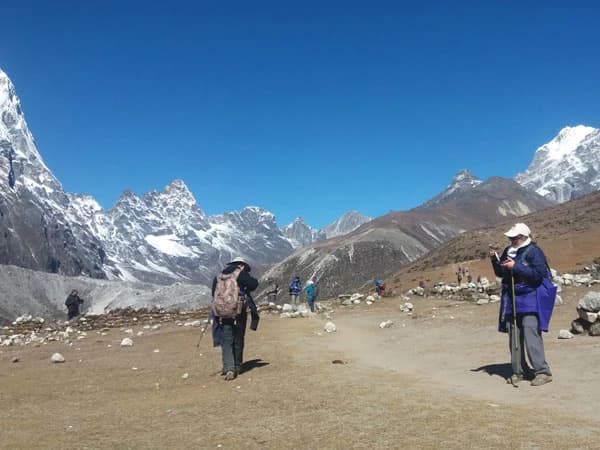
The Manaslu Circuit Trek is located in Nepal's Gorkha district near the Tibetan border. The route encircles Mount Manaslu while passing through remote Himalayan valleys and villages with strong Tibetan Buddhist heritage. The trail starts from Machha Khola at around 900 meters, reached by a seven to eight-hour jeep drive from Kathmandu through the Budhi Gandaki valley.
The full circuit covers roughly 175 kilometers of trail. It passes through Jagat, Deng, Namrung, Lho, Samagaon, Samdo, and Dharamsala before crossing Larkya La Pass and descending through Bimthang to Dharapani on the Annapurna side.
Why Manaslu feels more remote than Everest or Annapurna
Everest Base Camp drew around 50,000 trekkers in 2024. The Annapurna region saw close to 250,000. Manaslu received approximately 12,000. That is not just a crowd difference. It is an infrastructure difference. Above Namrung, tea houses become simpler. WiFi disappears. Charging is solar-dependent. Medical facilities do not exist above Machha Khola. The route feels significantly more isolated than anything on the Everest or Annapurna circuits, and that isolation is exactly why local guide experience matters so much here.
How difficult is the Manaslu Circuit Trek?
The route is classified as moderate to strenuous. Most trekkers spend 14 to 18 days on the circuit. Several days exceed seven to nine hours of walking, particularly the approach to Dharamsala and the Larkya La crossing itself, which takes 10 to 11 hours. Above Samagaon at 3,530 meters, reduced oxygen affects recovery speed, appetite, sleep quality, and trekking pace in ways most trekkers underestimate before experiencing them.
Why proper local support matters more on remote treks
Once you cross Jagat on day three, your options for turning back and fixing problems become limited. There are no road exits through the upper circuit. Helicopter evacuation is available in emergencies but depends on weather windows. The route commits you to its logic. Having a guide who has navigated that logic across multiple seasons is what keeps that commitment safe.
What Does Local Guide Support Mean on the Manaslu Trek?
Local guide support on the Manaslu Trek includes altitude management, route planning, weather judgment, tea house coordination, and remote trekking logistics, not just trail navigation. Most of what guides do on Manaslu happens before 8 a.m. and after 5 p.m., when the group is not walking.
What guides actually do each day on the Manaslu route
The practical daily work of a Regal Nepal Treks guide on Manaslu includes:
-
Checking oxygen saturation readings for each trekker before departure using a pulse oximeter
-
Assessing morning weather above Dharamsala before committing to the Larkya La crossing
-
Pre-book rooms at the next stop to avoid the accommodation shortages that hit peak-season arrivals without reservations
-
Managing all checkpoint registrations at the permit stations in Jagat, Namrung, Samagaon, and Samdo
-
Adjusting daily departure time based on trail conditions and the group's recovery from the previous day
A guide is not a trail sign. They are a real-time decision-maker with route-specific information you cannot Google above 4,000 meters.
Difference between guides and porters
Guides manage route safety, altitude monitoring, logistics coordination, and weather decisions. Porters carry equipment. The distinction matters because some operators blur this line, sending a porter with basic navigation knowledge to serve as a guide. On a restricted area route like Manaslu, your guide must hold a government license. Always verify this before you book. Regal Nepal Treks assigns only government-licensed, English-speaking lead guides on every Manaslu departure.
Why local mountain knowledge matters specifically on Manaslu
Competitors writing about guide value on Manaslu tend to use general language: "guides help with altitude" and "guides manage logistics." Here is what that actually means in specific terms.
Our guides know that the section of Larkya La between 4,800 meters and the summit ridge becomes icy in the pre-dawn hours of October mornings. They know which tea house in Deng has the most reliable solar charging. They know that the landslide-prone section of trail between Jagat and Salleri is most dangerous in the 48 hours following rain, not during rain. That level of information comes from repeated exposure to this specific route, not from reading a trekking manual.
Why Manaslu requires licensed guides
Nepal's restricted area regulations for Manaslu require all foreign trekkers to carry a Manaslu Restricted Area Permit (MRAP) and travel with a registered, licensed guide from a government-recognized trekking company. A minimum of two foreign trekkers must apply together for the MRAP. Solo trekkers must join a group or arrange private guide support. Independent trekking is not legally permitted in the Manaslu restricted zone.
Why Trek the Manaslu Circuit With Local Guides?
Experienced local guides help trekkers acclimatize more safely by controlling trekking pace, monitoring altitude symptoms, and adjusting daily movement based on weather and physical condition. Beyond safety, they reduce the decision load on a route where making the wrong call at altitude has real consequences.
How local experience improves safety outcomes
The most common reason trekkers fail to complete the Manaslu Circuit or require evacuation is not extreme weather or sudden illness. It is a series of small decisions made incorrectly over several days: walking a little too fast in the lower section, skipping a rest break above 3,500 meters, and not drinking enough water because appetite is suppressed at altitude. A guide who has seen this pattern across 20 to 30 Manaslu departures recognizes it and corrects it before it compounds.
When our team reached Samagaon with one group in October 2024, two trekkers had oxygen saturation readings that had dropped from 96 to 87 overnight. Neither felt dramatically different. Both were ready to push on. Our guide called a rest day. Twenty-four hours later, both readings were back to 93 and 94. The pass crossing happened the following day with no problems. Without that rest day call, both trekkers would have hit Larkya La already compromised.
Why beginners feel more comfortable with group guide support
First-time high-altitude trekkers consistently report that the mental difficulty of remote trekking is underestimated before the trek. The isolation above Samdo, the physical unpredictability of altitude, and the knowledge that you cannot easily exit the route create psychological pressure that compounds physical fatigue. Guides manage that mental environment. They normalize what is happening, provide pacing structure, and keep the group's focus forward.
What shared logistics remove from your mental load
On the Manaslu Circuit, the following logistics run simultaneously and must be coordinated correctly:
-
Permit checkpoint registrations at four separate stations
-
Tea house availability at Samagaon and Dharamsala during the October peak season
-
Jeep transport coordination from Kathmandu to Machha Khola and return from Besisahar
-
Weather monitoring for the Larkya La crossing window
-
Real-time altitude monitoring across multiple trekkers
-
Emergency communication protocols if evacuation becomes necessary
Regal Nepal Treks handles every item on that list. You handle walking and recovery.
What Makes the Manaslu Trek Challenging Without Experienced Local Support?
Trekking without experienced local support on remote routes like Manaslu increases altitude risk, logistical exposure, and weather vulnerability because emergency services and infrastructure are limited.
High altitude and acclimatization challenges
The route crosses above 3,500 meters for multiple consecutive days before reaching Larkya La at 5,106 meters. At this altitude, oxygen saturation in healthy trekkers typically drops to 70 to 80 percent of sea-level values. Even fit trekkers with no prior altitude problems can develop AMS symptoms above 4,000 meters. AMS does not select by fitness level. It selects based on ascent rate and acclimatization quality.
Without a guide monitoring saturation and recognizing the difference between acceptable altitude fatigue and developing AMS, trekkers make this judgment themselves. Most first-time high-altitude trekkers make it poorly because they cannot objectively assess their own cognitive impairment, which is itself a symptom of altitude stress.
Long trekking days and cumulative fatigue
The Manaslu Circuit does not have easy exit days. Consecutive trekking days at altitude create cumulative fatigue that builds in ways most trekkers have not experienced before. Day eight above 3,000 meters feels harder than day three, not because the trail is steeper, but because your body has been working against reduced oxygen for a week. Guides who understand this curve manage pace differently across the trip, faster in the lower section, much more conservative above 3,500 meters.
Limited infrastructure and changing weather conditions
Above Samagaon, what you see is what you get. There are no pharmacies, no gear shops, no reliable WiFi for researching symptoms or calling for advice. Tea house menus shrink. Charging options are solar-dependent and unreliable. The infrastructure that most trekkers take for granted on Everest or Annapurna routes does not exist here in the same form. Guides who know the route compensate for this through preparation, not improvisation.
Larkya La Pass crossing challenges
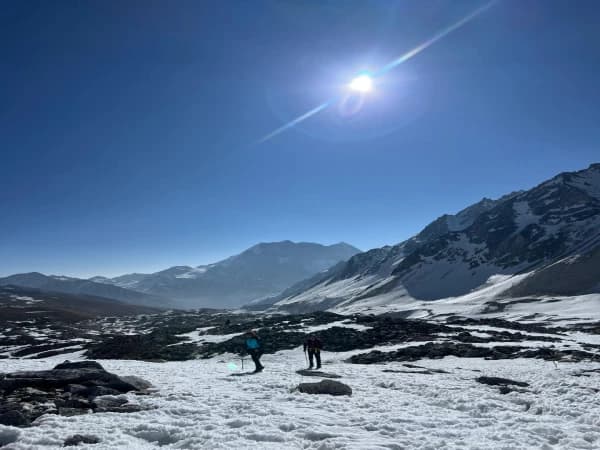
The pass crossing starts at 3:30 to 4:00 a.m. from Dharamsala at 4,460 meters. The first two hours of climbing happen in complete darkness on rocky terrain. The final approach involves loose scree and, in some conditions, icy sections. At the summit, temperatures can hit minus 10 to minus 15 degrees Celsius with wind chill. The descent to Bimthang drops 1,400 meters on steep, knee-intensive ground and takes three to four hours after the climb. Making this crossing without someone who knows the timing windows, weather indicators, and emergency protocols is a significant risk.
Why remote trekking mistakes compound at altitude
At lower elevations, poor decisions have smaller consequences. At 4,500 meters, dehydration accelerates AMS. Walking slightly too fast increases heart rate beyond what acclimatization supports. Ignoring an early headache and continuing to ascend can turn mild AMS into HACE (high-altitude cerebral edema) within hours. The margin for error on Manaslu is narrower than on any popular Nepal trek. Local guides understand this margin through direct experience, not theory.
How Do Local Guides Help Trekkers Stay Safe on the Manaslu Trek?
Experienced guides recognize altitude-related problems early and make pacing or route decisions that prevent serious medical situations from developing. They also manage the communication and evacuation logistics that most independent trekkers are unprepared for.
Monitoring altitude sickness symptoms throughout the trek
At Regal Nepal Treks, our guides carry pulse oximeters on every Manaslu departure. They check oxygen saturation and resting heart rate for each trekker at the following points:
-
Every morning before the day's walking begins
-
At every rest stop above 3,500 meters
-
After arriving at each new tea house above 4,000 meters
This is not anecdotal symptom checking. It produces actual numbers that guide tracking across days to identify trends. A saturation reading that drops from 92 to 87 over two consecutive nights is a warning sign, even if the trekker reports feeling fine. Our guides are trained to act on the number, not the self-report.
AMS symptom monitoring
Guides actively monitor for:
|
Symptom Category
|
Signs
|
Guide Response
|
|
Mild AMS
|
Headache, fatigue, poor appetite
|
Rest, hydrate, hold altitude
|
|
Moderate AMS
|
Persistent headache, nausea, dizziness
|
Rest day, descend if no improvement in 24 hours
|
|
Severe AMS/HACE
|
Confusion, ataxia (loss of balance), and breathing difficulty at rest
|
Immediate descent, emergency contact initiated
|
|
HAPE indicators
|
Cough at night, pink frothy mucus, severe breathlessness
|
Descent and evacuation
|
Most AMS situations our guides encounter on Manaslu are mild and resolve with a rest day and proper hydration. The critical skill is distinguishing mild from developing moderate, which requires experience watching altitude responses in real time across multiple trekkers.
Managing acclimatization and daily trekking pace
The "Nepali pace" taught by local guides is not slow for the sake of being gentle. At altitudes above 3,500 meters, walking pace determines heart rate, which determines the oxygen demand placed on a body that is already working with 40 percent less available oxygen than at sea level. Walking at your natural lowland pace above 4,000 meters consumes your reserves for the day within the first two hours. Guides set a pace that distributes effort evenly across a 7 to 10-hour trekking day.
Making safe route and weather decisions on pass day
The decision to cross Larkya La or delay is not made on the morning of. Our guides begin assessing conditions three days before the scheduled crossing. They watch cloud formation direction over the southern face of Manaslu, monitor evening temperature drops at Samdo, and check in with guides on the route ahead. If the morning of crossing reveals icing on the approach that was not there the previous evening, they delay. No schedule pressure overrides a safety call on Larkya La.
Handling emergencies in remote terrain
Regal Nepal Treks guides carry satellite communication devices on all Manaslu departures. In an emergency requiring evacuation, they initiate contact with helicopter services in Kathmandu before conditions can worsen. Helicopter evacuation from the Manaslu restricted area costs between $3,000 and $6,000 USD, depending on pickup location and weather delays. Travel insurance covering evacuation above 5,000 meters is mandatory for all trekkers on our departures. We verify insurance documentation before the trek begins.
How Local Guides Improve Acclimatization on the Manaslu Circuit
Proper acclimatization support from experienced local guides significantly improves trekking safety on Manaslu because altitude adjustment becomes harder above 3,500 meters and does not self-correct without rest and managed ascent.
Planning realistic daily trekking schedules
The biggest acclimatization mistake on Manaslu is choosing a 10 or 11-day itinerary that removes rest days to save time. A 10-day Manaslu itinerary has zero built-in acclimatization days. Research from high-altitude medicine consistently shows that trekkers who spend at least one night at Samagaon before ascending to Samdo have significantly lower AMS rates on pass day than those who do not.
Regal Nepal Treks recommends 14 to 16 days for most trekkers. Our standard acclimatization schedule includes:
-
Rest day at Samagaon (3,530m) with a day hike to Pungyen Gompa (4,000m) or Manaslu Base Camp viewpoint
-
Option for second rest day at Samdo (3,860m) for trekkers showing borderline saturation readings
-
Conservative departure from Dharamsala for the pass crossing based on individual group readiness, not fixed schedules
Recognizing when trekkers need additional rest
Altitude fatigue looks different from normal tiredness. Normal fatigue responds to rest. Altitude fatigue can persist through a full night's sleep and present as cognitive slowness, poor decision-making, and emotional flatness the following morning. Experienced guides recognize this pattern because they see it in groups. A trekker who seems quieter than usual at dinner and picks at their dal bhat without appetite is showing signs that warrant attention the next morning, before the group departs.
Encouraging proper hydration and pacing
Four to five liters of water daily above 3,000 meters is the baseline hydration target. Most trekkers drink less because altitude suppresses thirst along with appetite. Guides actively prompt hydration at every rest stop, carry ORS sachets for trekkers showing signs of electrolyte depletion, and discourage alcohol above 3,500 meters because it disrupts sleep quality and increases dehydration at altitude.
Why acclimatization support near Larkya La matters most
The route from Samdo to Dharamsala (3,860 to 4,460 meters) covers 600 meters of elevation gain on a day typically classified as short and easy. It is not easy. It is the last altitude gain before the 5,106-meter crossing, and how a trekker's body responds to the night at Dharamsala determines their pass day performance. Guides who push this section fast to save afternoon rest time are creating problems for the following morning. Our guides take this section deliberately slowly.
Why Local Route Knowledge Matters on the Manaslu Trek
Real mountain experience matters on Manaslu because Himalayan weather, trail conditions, and remote logistics change in ways technology alone cannot reliably predict or manage.
Understanding weather and seasonal trail conditions
The weather pattern near Larkya La does not match textbook mountain weather descriptions. In late October, clear mornings can develop cloud and snow on the summit ridge by 10 to 11 a.m. from the Tibetan side. Groups that leave Dharamsala late, after 5 a.m., rather than before 4 a.m., consistently have a harder pass crossing because of deteriorating afternoon conditions. Our guides build this departure time into the schedule without exception, regardless of how warm and clear the morning feels.
Navigating landslide-prone sections
Several sections of the lower Manaslu route between Soti Khola and Jagat pass through terrain that becomes genuinely unstable in the 48 hours after heavy rain. The danger is not during rain. It is after, when saturated soil continues moving above the trail sections. Guides with route familiarity identify these sections and either time passage carefully or use alternative lines when conditions are marginal.
Adjusting trekking plans during changing conditions
Weather above Samdo and Dharamsala can change the schedule across multiple days, not just the crossing day itself. Snow on the approach to Larkya La sometimes requires an extra day at Dharamsala. Our guides communicate these adjustments clearly and manage the tea house logistics that a schedule change requires. Independent trekkers facing the same weather have no pre-established communication with tea houses ahead and no experience reading whether conditions will improve or worsen.
Knowing tea house systems and remote village logistics
Tea house availability at Samagaon in the peak October season is limited. Groups without bookings sometimes find accommodation full at the end of a long trekking day. Our guides pre-book accommodation at all key stops from Kathmandu before departure. This is not a small logistical detail. Arriving at Dharamsala after a long climbing day to find available rooms is the difference between proper rest before the crossing and a cold, stressful night that undermines the next morning's performance.
Why GPS and apps cannot replace route judgment
Maps.me and offline GPS apps are useful tools on Manaslu. They are not sufficient substitutes for route experience. They cannot tell you which section of the trail near Salleri is undercut by the river after heavy monsoon erosion. They cannot read the wind direction on Larkya La and tell you whether it will deteriorate or stabilize in the next two hours. They cannot assess whether a trekker's low energy at Dharamsala is a normal altitude response or early HACE. Local experience answers questions that technology cannot ask.
What Is the Trekking Experience Like With Local Guides on Manaslu?
Trekking with a local guide often feels more immersive because trekkers gain cultural insight, better pacing structure, and local mountain knowledge throughout the journey, in addition to safety management.
Daily trekking life in remote Himalayan villages
Daily trekking on Manaslu moves at a genuinely slower rhythm than any commercial trekking circuit. Villages remain small and connected to Himalayan traditions that have not been significantly altered by tourism. Mornings near Samagaon are quiet in a way that most trekkers find surprising: no trail traffic, no gear vendors, no chai shops with pop music. Prayer wheels turn at village entrances. Yaks move through morning mist above Samdo. The experience feels earned in a way that crowded routes do not.
Tea house accommodation and mountain hospitality
Tea houses above 3,500 meters are simple and cold at night, but the hospitality inside the dining hall compensates for the basics of the rooms. Most trekkers remember the communal evenings around wood stoves more vividly than the mountain views, which says something about what this kind of trekking actually delivers. Bring a sleeping bag rated to minus 10 degrees Celsius. Tea house blankets at Dharamsala are insufficient on their own.
Learning local culture and traditions during the trek
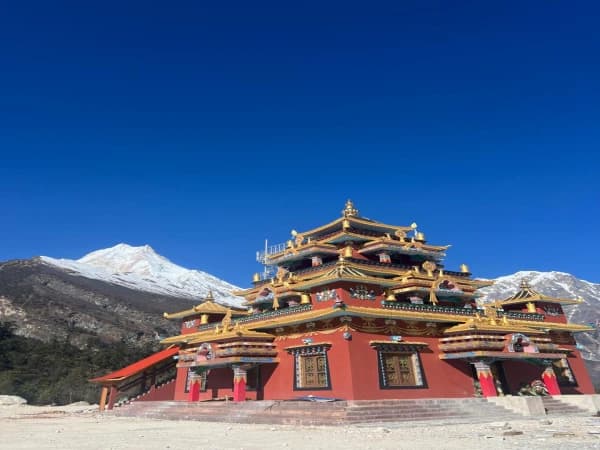
The Manaslu region carries a strong Tibetan Buddhist heritage rooted in the Nubri and Tsum cultures near the Tibetan border. The trail passes Ribung Gompa in Lho, Pungyen Gompa above Samagaon, and several mani walls and prayer flag installations that local guides can explain in cultural context. Our guides grew up in Himalayan communities connected to these traditions. That cultural knowledge adds a dimension to the trekking experience that a route description on a trail app cannot.
Experiencing quieter trails away from crowded routes
The Manaslu Circuit was closed to foreign trekkers until 1991. Much of its traditional culture remains intact precisely because mass tourism arrived late and remains limited by permit. Walking through Samagaon without a crowd of trekkers behind you changes how the place feels. You notice the architecture, the farming systems, the way children interact with the trail as part of their daily geography. That quietness is a primary reason experienced trekkers choose Manaslu over any other Nepal circuit.
Why Local Guides Are Especially Helpful for Beginners on Manaslu
Beginners benefit most from local guide support because experienced guides help manage acclimatization, route logistics, mountain safety, and mental confidence during difficult high-altitude trekking days.
Helping trekkers manage altitude and pacing
Himalayan trekking requires a slower movement rhythm than most beginners expect. Their instinct on low-angle terrain in the early days is to walk at their normal hiking speed. This is always too fast above 3,000 meters. Guides calibrate pace from the first day, creating a movement habit that protects the trekker as the route climbs higher.
Building confidence during difficult trekking days
The day above Dharamsala and the pass crossing itself is a mental challenge as much as a physical one. Starting in complete darkness at 3:30 a.m., climbing into cold wind above 4,800 meters with thin air and visible exposure, and then descending on tired legs to Bimthang pushes most first-timers to a difficult place. Guides who have seen this day many times know how to frame it for first-timers: what to expect at each stage, when the hardest part is actually over, and how to read the mountain for confirmation that conditions are normal. That contextual knowledge keeps beginners moving when experience alone would not.
Reducing beginner mistakes at altitude
The five most common beginner mistakes our guides prevent on Manaslu:
-
Walking too fast in the lower section because it feels easy. This creates debt that compounds above 3,500 meters.
-
Under-hydrating because altitude suppresses thirst. Guides actively prompt water intake at every stop.
-
Ignoring early AMS signs because they feel manageable. Guides respond to the saturation reading, not the self-assessment.
-
Overpacking and then struggling with a day pack weight above 4,000 meters. Our pre-trek gear check in Kathmandu catches this before departure.
-
Underestimating Larkya La preparation. Guides confirm gear readiness, snack supply, and hydration loading the evening before the crossing.
What Cultural Experiences Do Local Guides Add to the Manaslu Trek?
Local guides on the Manaslu Trek explain Tibetan Buddhist culture in Samagaun and Samdo and how it shapes daily life. They also connect yak herding and high-altitude living in the Nubri Valley to survival practices. This turns the trek into a cultural experience, not just a walk.
Visiting Tibetan-influenced villages and monasteries
The Manaslu region's proximity to the Tibetan border shaped its culture deeply. Villages like Samagaon and Samdo maintain Buddhist traditions through active monasteries, community prayer practices, and seasonal festivals connected to the agricultural calendar. Trekkers who walk through without a cultural context miss most of what makes these places significant.
Understanding mountain traditions and local lifestyles
Our guides explain yak herding patterns and how altitude determines which animals can graze where. They describe the seasonal migration between lower and upper villages that Nubri families have practiced for generations. They point out the significance of specific prayer flag colors and mani wall carvings that look decorative to an outside eye but carry precise meaning in Buddhist practice. These explanations turn a mountain walk into a genuine cultural encounter.
Building deeper connections with Himalayan communities
Many trekkers who complete Manaslu with guided support describe the human connections as unexpectedly central to the experience. Tea house owners who recognize returning guides by name, village children who know certain guides from previous seasons, and the respect that local communities show toward guides they know create a social warmth that independent trekkers do not access in the same way.
Learning local trekking history along the route
The Manaslu Circuit was closed to foreign trekkers until 1991. Before that, the region was effectively off-limits due to its proximity to the Tibetan border. Our guides share this history in context: why certain sections of the trail were historically significant for Tibetan salt trade routes, which villages served as rest stops for traders, and how the trekking permit system changed the economic relationship between villages and the outside world.
Crossing Larkya La Pass With Local Guide Support
Crossing Larkya La safely depends on weather timing, acclimatization, route judgment, and emergency readiness. This is the section of Manaslu where local guide experience matters most and where the difference between a good guide and a poor one is most visible.
Why Larkya La is the hardest day of the trek
At 5,106 meters, the pass has roughly 50 percent of sea-level oxygen. Trekkers who arrive here well-acclimatized and properly paced find it hard but manageable. Those who arrive compromised by days of poor hydration, insufficient rest, or too-fast ascent find it genuinely dangerous. The 10 to 11-hour crossing day involves 650 meters of gain to the summit and 1,400 meters of steep descent to Bimthang. Both sections are demanding under the best conditions.
How guides decide safe crossing timing
Our guides make the go or no-go decision for Larkya La based on three factors:
-
Weather window: Departure before 4 a.m. to reach the summit before afternoon deterioration
-
Group condition: Oxygen saturation readings and resting heart rates from the previous two nights
-
Trail conditions: Reports from guides already on the route and visual assessment of snow or ice on the upper approach
When any factor is marginal, we delay. No client itinerary constraint overrides a safety judgment on this day.
Snow and weather judgment on the pass
Snowfall on the approach to Larkya La changes the crossing from difficult to genuinely dangerous without proper footwear and careful pacing. Our guides carry information about snow depth from guides who have crossed in the previous 24 to 48 hours. In heavy snow years, crampons or microspikes become necessary. We communicate this information during the pre-trek briefing and ensure trekkers bring or rent appropriate footwear before departure from Kathmandu.
Emergency decision-making during difficult mountain conditions
If a trekker develops severe symptoms on the pass or descent, our guides initiate emergency response immediately. The descent to Bimthang is the fastest available descent. Our satellite communication device contacts helicopter services in Kathmandu while the guide manages the trekker's condition. Bimthang at 3,720 meters is the standard helicopter landing zone for evacuations from the Larkya La area. Our guides know this protocol and have practiced it. Most independent trekkers have not considered what they would actually do in this situation before they are in it.
What Should Trekkers Look for in a Local Guide Team on Manaslu?
Trekkers should choose a guide team with first-aid training, oxygen monitoring, and evacuation readiness. They should also have real Manaslu route experience, not just general trekking. Responsible trekking in the Manaslu Conservation Area is also essential.
High-altitude trekking and first-aid training
Every Regal Nepal Treks guide assigned to Manaslu holds a government-issued trekking guide license and has completed wilderness first aid training. They carry pulse oximeters, a full first aid kit, and emergency communication equipment. When choosing any operator for Manaslu, ask specifically: Does your guide carry a pulse oximeter? Do they have first aid certification? What is your emergency evacuation protocol?
Local route familiarity, not just general Himalayan experience
General Himalayan trekking experience is not the same as Manaslu-specific knowledge. A guide who has completed the Annapurna Circuit 30 times but walked Manaslu twice does not have the route knowledge that a guide with 15 Manaslu departures across different seasons carries. Ask how many times your assigned guide has completed the Manaslu Circuit specifically, and in which seasons.
Communication skills and cultural understanding
A guide who communicates clearly in English, explains altitude management decisions in real time, and creates cultural context for the villages and monasteries along the route adds measurably to the experience. Communication also matters in emergencies. A guide who can clearly explain a situation to helicopter rescue services in Kathmandu and to the trekker simultaneously is managing a crisis effectively.
Responsible and sustainable trekking practices
At Regal Nepal Treks, our guides are trained in Leave No Trace principles specific to the Manaslu Conservation Area. We brief trekkers on waste management expectations before departure, including the need to carry out non-biodegradable waste from sections above Samdo where tea house waste systems are limited. Responsible trekking on Manaslu protects the environmental conditions that make the route worth trekking.
Best Time to Trek Manaslu With Local Guides
Spring and autumn are the best seasons for guided trekking on the Manaslu Circuit because weather conditions are more stable and Larkya La Pass is safer to cross.
Why autumn is the most popular season
Autumn runs from September to November. Post-monsoon air is clear, and visibility across the Manaslu, Himalchuli at 7,893 meters, Ganesh Himal, and Annapurna ranges is at its best. October is peak season. The MRAP permit costs $100 per person for the first seven days in peak season (September through November). October departures fill first. Book and confirm with your guide team at least three months before an October departure.
Why spring offers a different but equally rewarding experience
Spring runs from March to May. Rhododendron forests below 3,500 meters bloom through March and April, adding a visual dimension to lower sections that autumn cannot match. Larkya La snow from winter begins consolidating through April, making April the most reliable spring crossing month. The MRAP permit costs $100 per person during March through May as well. May is warmer at lower elevations but carries more afternoon cloud development above 4,000 meters than April.
Why does winter trekking become more difficult
December through February brings deep snowfall on the upper circuit and icing on Larkya La that makes crossing dangerous without mountaineering equipment. Most tea houses above Namrung close by late November. Regal Nepal Treks does not run scheduled Manaslu departures in December through February for beginner or intermediate trekkers.
Monsoon challenges on the Manaslu route
June through August brings sustained rainfall, leeches on lower trail sections, landslide risk on the Budhi Gandaki gorge sections, and cloud cover that eliminates mountain views for days at a time. We do not operate scheduled group departures during the monsoon season.
Common Mistakes Trekkers Make Without Local Support
Many trekking problems on the Manaslu Circuit occur because trekkers underestimate altitude, misread weather exposure, or choose itineraries that prioritize time over acclimatization.
Walking too fast in the early days
Fast pacing on the easier lower sections between Machha Khola and Namrung creates acclimatization debt that surfaces above Samagaon when the body most needs its reserves. Guides enforce a controlled pace from the first day because lower-section behavior determines upper-section safety.
Ignoring altitude symptoms until they become serious
Mild AMS symptoms are so common above 3,500 meters that many trekkers dismiss them as normal discomfort. They are normal in the sense of being expected. They are not normal in the sense of being ignorable. A guide who checks oxygen saturation readings daily catches the deterioration that self-assessment misses.
Choosing unrealistic itineraries
A 10-day Manaslu itinerary has no acclimatization days. A 12-day itinerary has one. Neither is appropriate for most trekkers, and particularly not for first-time high-altitude trekkers. Success rates on Manaslu with proper acclimatization (14 to 16 days) run consistently higher than on compressed itineraries. The time investment in an extra two to four days is the best safety margin available on this route.
Misjudging remote trail difficulty
The Manaslu Circuit does not feel like Everest or Annapurna in its infrastructure or support systems. Trekkers who assume similar availability of pharmacies, gear shops, communication, and emergency services make planning decisions that create vulnerability above Jagat. This is a route that requires preparation to be completed before the trailhead.
What Trekkers Usually Love About Local Guide Support on Manaslu
Feedback from Regal Nepal Treks Manaslu clients consistently highlights three things: feeling genuinely safe at altitude, learning things about the route they could not have found independently, and finishing the circuit with a relationship with their guide that felt real rather than transactional.
The cultural depth that comes from walking through Samagaon with a guide who explains the significance of Pungyen Gompa and the seasonal patterns of the Nubri community transforms a mountain walk into something that stays with people long after the physical effort has faded. The shared challenge of Larkya La pass day creates a connection between trekkers and guides that feels earned because it is.
The logistics reduction is also consistently mentioned. Not having to think about permits, accommodation, weather decisions, or altitude management leaves mental space for the experience itself: the view of Manaslu's south face from above Samagaon, the first sight of the Annapurna range from the summit of Larkya La, the descent through pine forest to Bimthang.
Manaslu Trek With Guides vs Independent Trekking
With a licensed guide, the Manaslu Trek includes legal compliance, altitude monitoring, and full safety support. Guides handle permits, weather decisions, bookings, and emergencies, which is critical in remote high altitude zones. Independent trekking is not allowed and leaves all risks and logistics on the trekker.
|
Factor
|
With Licensed Guide (Regal Nepal Treks)
|
Without Guide
|
|
Legal status
|
Fully compliant with restricted area regulations
|
Not permitted. MRAP requires a licensed guide
|
|
Altitude monitoring
|
Pulse oximeter checks daily above 3,500m
|
Self-monitoring only
|
|
Acclimatization management
|
Guide-managed pace and rest day decisions
|
Self-managed
|
|
Tea house bookings
|
Pre-booked from Kathmandu
|
Arrive and hope for availability
|
|
Emergency response
|
Satellite communication, evacuation coordination
|
Independent phone/radio if available
|
|
Permit management
|
All permits handled
|
Self-arranged (requires a registered company anyway)
|
|
Weather decisions
|
Route-specific judgment from guide experience
|
Weather apps and self-judgment
|
|
Cultural insight
|
Active guide interpretation throughout
|
Trail signage only
|
|
Pass day preparation
|
Guide-briefed, gear-checked, condition-assessed
|
Self-managed
|
The comparison is essentially academic because independent trekking is not legally permitted on Manaslu. But the table illustrates why the guide requirement exists beyond legal compliance.
Is Trekking Manaslu With Local Guides Worth It?
Trekking the Manaslu Circuit with experienced local guides usually feels safer, smoother, and more rewarding because local expertise improves acclimatization, logistics, weather decisions, and overall trekking confidence. The route demands it. The permit system requires it. But the real value is experienced in the daily reality of having someone who has done this before, managing the variables that matter most.
The trekkers who get the most from Manaslu are the ones who use their guide actively: asking questions about what they are seeing, following pace and rest day guidance without pushing back, and treating the guide as the expert on this specific route that they are. The mountain knowledge our guides carry on Manaslu has been built across seasons, departures, and conditions that no guidebook or GPS app replicates.
Expert Recommendations From Regal Nepal Treks Guides
Trekkers should walk slowly, prioritize acclimatization, and keep a light day pack under 7 kg at high altitude. They must hydrate on schedule, eat full meals, and respect weather decisions on Larkya La Pass. Above all, pace and safety matter more than itinerary timing on the Manaslu Circuit.
Walk slowly at altitude. The correct pace above 3,500 meters is slower than it feels necessary. If you can hold a conversation without breathing heavily, your pace is right.
Prioritize acclimatization over schedule. An extra rest day at Samagaon costs you one day. Missing the circuit completion costs you the entire trip.
Keep your day pack under 7 kilograms. Your guide will tell you this in Kathmandu. Listen before you discover it on the trail above Namrung.
Drink four to five liters of water daily above 3,000 meters. Your thirst signal is suppressed at altitude. Drink to schedule, not to thirst.
Respect the weather on Larkya La. The pass decides the crossing time, not your return flight from Kathmandu.
Eat full meals at every tea house opportunity. Appetite suppression at altitude is real. Force a full dal bhat at dinner even when you do not feel hungry. You need the fuel.
Trek Manaslu With Regal Nepal Treks
At Regal Nepal Treks, our guides are government-licensed and experienced across multiple Manaslu seasons. We arrange required permits (MRAP, MCAP, ACAP), manage logistics, and organize transportation between Kathmandu and the trailhead. We also provide a pre-trek briefing covering altitude strategy, gear preparation, and emergency planning. Departures are available in spring (March-May) and autumn (September–November), with updated itinerary planning based on season and trail conditions.
We also offer private and group join departures in spring (March to May) and autumn (September to November). Our team provides updated trail conditions, current permit information, and realistic acclimatization planning based on your specific departure date and fitness level before you commit to a booking.
FAQs About Manaslu Trek With Local Guides
Why is local guide support important on the Manaslu Trek?
Local guides manage altitude safety, pacing, weather decisions, and logistics like permits and tea houses. Their route-specific experience helps reduce AMS risk and improves overall trekking safety on this remote circuit.
Is a guide legally required for the Manaslu Circuit Trek?
Yes. The Manaslu Circuit is a restricted area, and all trekkers must have a licensed guide through a registered company. Independent trekking is not allowed under Nepal’s permit system.
How do guides help prevent altitude sickness on Manaslu?
Guides monitor oxygen levels, control ascent pace, and track early AMS symptoms daily above 3,500 meters. They adjust rest days or descent decisions based on real-time health data, not guesswork.
What is the difference between a guide and a porter on Manaslu?
A guide manages safety, route decisions, altitude monitoring, and emergency response. A porter carries your gear, helping reduce physical load so you can trek more efficiently at high altitude.